Build vs Buy: What Replacing $340 a Month of SaaS Actually Cost Me
Last updated: 8 August 2026
I cancelled $340 a month of software this year and replaced it with my own code. That is $4,080 a year. It sounds like the obvious win, and the cash part was. The rest of it was more complicated, and the complicated part is the useful bit.
What did I actually replace?
Five subscriptions, all of them things a solo operator running content and outreach ends up paying for:
- LinkedIn outreach automation, $100 a month. Replaced with a self-hosted connector that drives my own account. Market rates for this category run $30 to $300 a month, so I was mid-range.
- Buffer, $20 a month. Social scheduling. Replaced with my own post queue: a scheduler, a poller, and a direct connection to each network. Buffer bills roughly $6 per channel per month, so the cost scales with how many places you post.
- MailerLite, $50 a month. Email. Replaced with my own list, sequences, and sending. MailerLite starts around $10 to $20 a month and climbs with your subscriber count, which is the part people forget when they budget for it.
- ManyChat, $150 a month. Comment-to-DM automation. Replaced with my own keyword triggers, first DM, and follow-up sequences running on my own account. ManyChat bills by contact count, so the price climbs with your audience.
- Calendly, $20 a month. Booking. Replaced with my own booking and calendar flow, wired straight into the app. Calendly's paid tiers run $10 to $20 per seat per month.
All five had the same shape. Each was a thin layer over an API I could call myself, priced per seat or per channel or per subscriber or per contact, growing with my usage rather than with my revenue.
What does the replacement cost to run?
Not zero. This is where most build-your-own posts stop being honest.
- A Fly.io server, about $30 a month. My tooling runs as a small always-on service. That is the one replacement cost I can name exactly, and it is already close to a tenth of what I cancelled.
- Email sending. I send through an email API. It is free up to 3,000 emails a month and about $20 a month once you pass 50,000. Cheaper than list-priced email software, but not free forever.
- Scraping credits. Research and metrics run on a paid scraping platform. In July I ran out of credit in the middle of a competitor scrape and had to finish the job by hand. That is the failure mode nobody mentions: when you own the stack, you also own running out.
- Model spend. The content side calls a language model. This is the line item that actually moves, and it moves with how much you use it.
So the honest number is not $340 saved. Hosting alone takes $30 of it straight back, before any scraping credits or model spend. The real cash saving is closer to $290 a month than $340, and it is lumpier: a fixed subscription traded for a bill that moves with how hard I use it.
Did building my own paywall save money?
No. Nothing. And I would do it again.
I built my own paywall system: templates, server-side rendering, and an agent that runs controlled experiments and promotes or rolls back the winner. The obvious vendor for this is RevenueCat, and RevenueCat gives you a no-code paywall builder with A/B testing. It is free up to $2,500 in monthly tracked revenue, and 1% of tracked revenue after that. The paywall builder is included at every tier, free one included.
So the tool I replaced was costing me nothing.
I built it anyway because the vendor's version is the wrong shape for my problem, not the wrong price. Their paywall builder is configured one app at a time, by hand, in their dashboard. I run many branded apps and I need paywalls generated for each one programmatically, then tested by an agent. No amount of money turns a dashboard into an API.
Some things you build to save money. Some things you build because the vendor's version cannot be pointed at your problem. Do not confuse the two.
What is the real cost of building your own?
Time, and it is not close.
The $4,080 a year is easy to measure, which is exactly why people over-weight it. The hours are harder to measure and they are the whole decision. Every one of those replacements took time to build, and each one still takes time to maintain. In the same week I wrote this, I shipped two features into my own posting tool and found a live billing bug in one of my apps. A vendor would have owned both of those. I own them because I chose to.
Here is the part that makes it worth it anyway. Building is a one-off cost and the saving repeats. Every hour you take out of a weekly task is an hour back every week after that, and those hours go into the work that grows the business rather than the work that merely runs it.
That is the trade. You pay hours once to stop paying hours forever. It only works if the task actually repeats.
When should you build instead of buy?
A rule that has held up for me:
- Does it repeat? A weekly task is worth automating. A quarterly one almost never is. If you do it twice a year, pay someone.
- Is the vendor the wrong shape, or just expensive? Expensive is fine, you can negotiate or grow into it. Wrong shape does not get better. A dashboard you cannot call from code will still be a dashboard next year.
- Is the price growing with your usage or with your revenue? Per-channel and per-subscriber pricing punishes exactly the growth you are working for. A percentage of revenue does not.
- Can you afford to own the failure? When your own tool breaks at 2am, there is no support queue. If that thought makes you cold, buy.
Most solo operators should buy far more than they build. I build because software is what I do all day, so my hourly cost of building is unusually low and my tolerance for owning the breakage is unusually high. If that is not you, the $340 is cheap.
The saving turned out to be the smallest part
Here is what I did not plan for. Every tool I built to replace a subscription is now something my clients get.
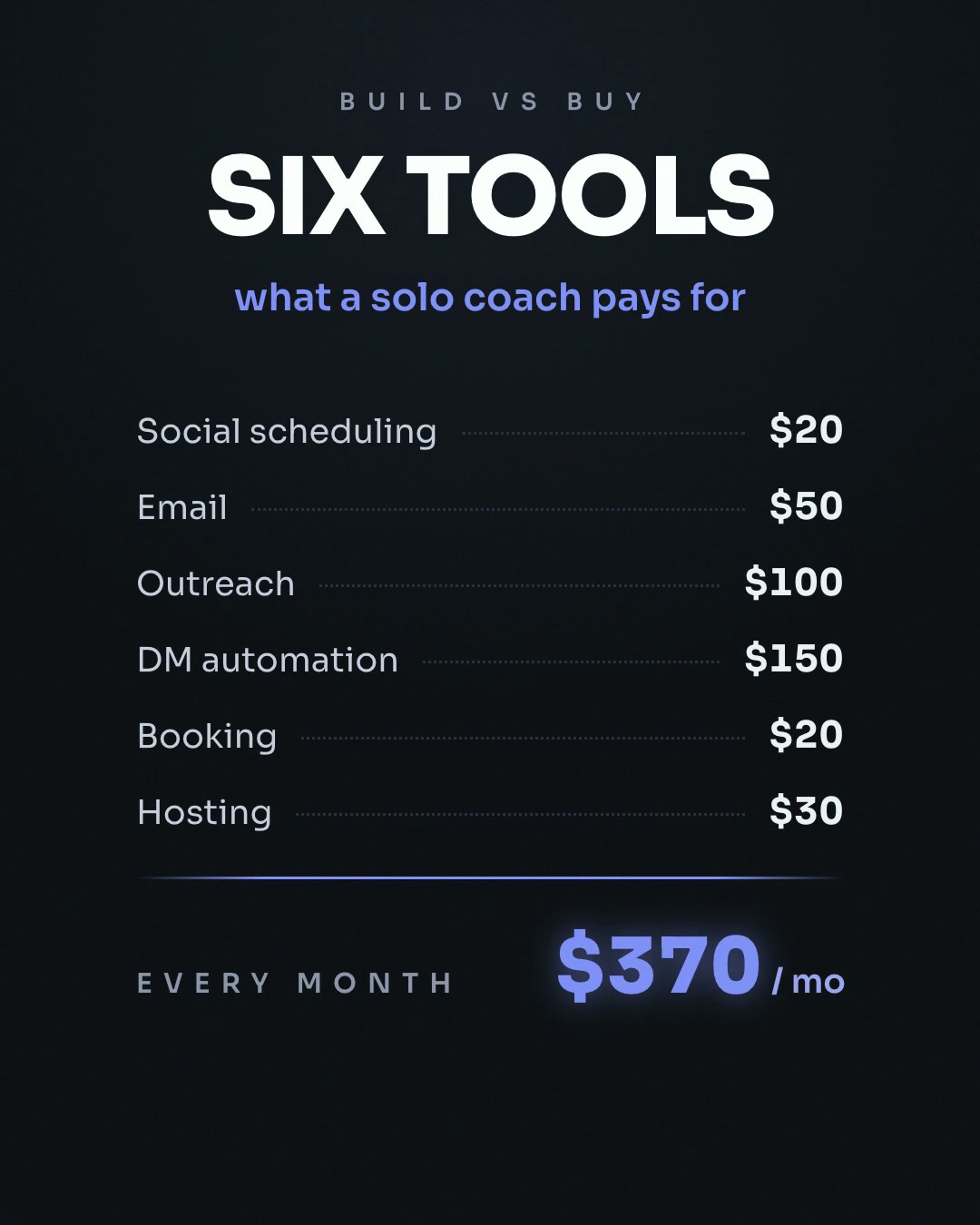
A coach who runs their business on Tribed gets the scheduling, the email, the outreach, the comment-to-DM automation, the booking, the paywall, and the hosting. Add up what they would otherwise be paying for that stack:
- Social scheduling: $20
- Email: $50
- Outreach automation: $100
- Comment-to-DM automation: $150
- Booking and calendar: $20
- Hosting for the app itself: $30
Three hundred and seventy dollars a month they do not spend, and six vendors they do not have to choose, learn, wire together, or keep working.
Note that is $370, not the $340 I cancelled. One of those lines was never my subscription to drop: the hosting, which I pay so they do not have to. That is the whole point. The costs did not disappear. They moved to the person who can absorb them once and spread them across everyone.

So the $340 stopped being a saving and became a feature. That is a completely different kind of return. A cost line turned into part of what I sell, and it raised what the product is worth at the same time as it lowered what it costs me to run.
Which adds a fifth question to the four above, and it is the one that flips the answer most often:
Can the thing you build become something you sell? If it can, the hours were never a cost. They were the product.
That is the case where building wins even when buying is cheaper, even when the vendor is the right shape, and even when the maths says do not bother. Most of the time it does not apply. When it does, it is decisive.
If you are weighing the same build-or-buy question for the app itself rather than the tooling around it, I put the 2026 numbers side by side in what it costs to build a coaching app.
Frequently asked questions
How much can you realistically save by replacing SaaS with your own tools?
I replaced $340 a month, or $4,080 a year, across social scheduling, email, outreach automation, comment-to-DM automation, and booking. Against that, budget for a server, an email API, any scraping or model usage, and your own maintenance time. The cash saving is real but smaller than the headline.
Is it worth building your own paywall?
Usually not. RevenueCat includes a paywall builder with A/B testing free up to $2,500 in monthly tracked revenue. Build your own only when you need paywalls generated programmatically across many apps, which is a shape problem rather than a cost problem.
What is the biggest hidden cost of building your own tools?
Maintenance, and the fact that you now own every failure. Running out of scraping credit mid-job, a billing bug in production, an expired token that silently stops your posts. A vendor absorbs all of that. When you build, it is your afternoon.
Should a coach or creator build their own software?
Almost never from scratch. The hours cost more than the subscription unless building is already your day job, or unless what you build becomes something you can sell. The better move is owning the thing that compounds, your audience and your offer, and renting the plumbing.
Get your app built for you
The point of taking hours out of the work that runs your business is to put them into the work that grows it. So if what you want back is the time rather than the code, do not build this one.
You can have a branded app carrying your programme, with an AI coach trained on your method and speaking in your voice, live on the App Store and Google Play. If you are wondering what an app like that actually earns, I broke down the real numbers in how much an app makes at every audience size.
Get your app built at admin.tribed.io
Sources: RevenueCat pricing 2026; Buffer pricing 2026; MailerLite pricing 2026; ManyChat pricing 2026; Calendly pricing 2026; LinkedIn automation pricing 2026; Resend pricing 2026. Subscription figures are what I personally paid.
Turn your expertise into a branded app business
Your programs, community, payments, content, automations, and an AI coach trained on your method and voice—built into one app for the App Store, Google Play, and web.