Two Years at $0: How Mobility Duo Built a Coaching Business for Snowboarders
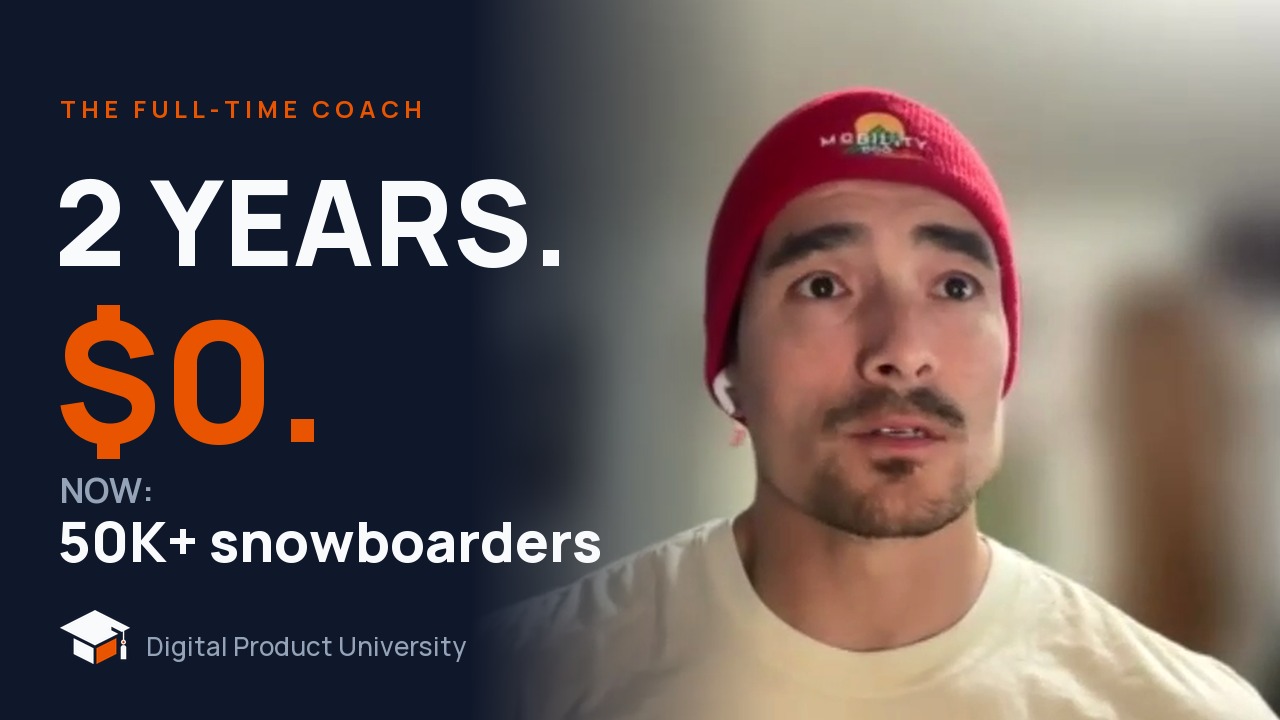
Mark and his wife Sarah run Mobility Duo, a training business for snowboarders. They started in August 2020 and made no money for the first two years. What changed it was one offer: a membership built around live yoga classes for snowboarders. Today Mobility Duo has a community of 50K+ snowboarders in 20+ countries and 339K followers on Instagram, and they sell a $30 a month membership, a library of 500+ recorded classes, and a set of dedicated programs, all on a platform they own.
Mark joined us on The Full-Time Coach, a podcast from Digital Product University where we interview people who make their living from coaching. We talked about how the work actually gets sold. Here is what he shared.
Watch the full episode on YouTube.
Who is Mark from Mobility Duo?
Mark is a doctor of physical therapy with a little over 20 years of strength training behind him. Sarah is a licensed massage therapist and yoga instructor. They combined both skill sets to focus on one group they love: snowboarders. Mark also works with professional athletes and has worked with US Ski and Snowboard.
How long did it take Mobility Duo to make money?
About two years. Mark worked in a clinic, Sarah had massage clients, and in the evenings they came home and made content. Educational posts, performance tips, and a lot of original funny videos.
We didn't make a dollar for first couple of years. It was just grinding.
The first revenue came through Patreon. Followers gave voluntary donations, and in return they got private classes. That became Snoga, their trademarked term for yoga for snowboarders, and the Snoga membership is where they made their first dollar. From there, Mark says, it snowballed. He is also honest about the misses: their first two Shred programs were not popular, and he thinks they are free now.
His view on the slow start is clear. Overnight success is not necessarily a good thing. A slow build gave them time to grow a mature business.
Why does a niche matter more than ever?
Mark thinks coaching is moving into a niche economy. If you are too broad, especially on social media, you fall into a giant ocean of a million other people who are just like you. A specific audience also makes trust easier, because people can tell when you are authentic.
He names three things that drive success: finding your niche and real passion, some luck, and grinding. Grinding, for him, means trying something, letting it fail, and moving on to the next thing.
What does the Mobility Duo funnel look like?
Mark calls it "funnel 101", and that is the point. Nothing exotic, just each step done well:
- Content that captures attention, mostly on Instagram, which has always been their main channel.
- Free guides: a mobility guide, a nutrition guide made with a registered dietitian who works with professional athletes, and a guide for injuries.
- Tiered paid products, matched to what each snowboarder needs.
- Newsletters, to keep the audience close.
Where they stand out is not the funnel. It is their education, which is hard to copy, and how authentic they are with their audience.
How is the membership priced and packaged?
- $30 a month or $240 a year, month to month, cancel any time.
- Two live Snoga classes a week, now taught by a new coach, Quinn, while Sarah is on maternity leave.
- Two HIIT classes a month for snowboarders, taught by Mark.
- 500+ recorded classes, sorted by goal (rotation, recovery, strength, rehab), each 30 minutes or less.
On top of the membership they sell dedicated programs. The flagship is a 12-week snowboard training program for under $200. There is also a bodyweight program, a follow-along program, and concussion programs built with other doctors.
Mark is firm that they do not want people who pay and never show up. He points out that the best customer for many gyms is the one who buys an annual pass and never comes in. For him, snowboarding is the reason his members keep coming back.
Why did they build their own platform instead of using a coaching app?
Mark says they have been approached by dozens of third-party platforms where a creator signs up, builds a course and a community, and invites people in. He thinks that works well for smaller creators. Mobility Duo wanted full control instead.
Their stack grew in stages:
- They started on WordPress with WooCommerce for subscriptions and orders, and Stripe for payments.
- Today they run on Shopify, with their own program system built inside it by a dedicated programmer.
- Videos are hosted on Vimeo and embedded, so they own them.
The two reasons he gives are autonomy and the percentage each platform takes from every transaction. The cost is real: he keeps active programmers on the team, because there are always bugs, changes and updates.
This is the trade-off we built Tribed for. You get your own branded app, your own members, and your own payments, without hiring a developer to keep it running.
How does Mark use AI?
Every day, as a tool. He uses it for content title ideas, for variations on exercises, and on the platform side for data: what people click, demographics, keywords and SEO. For programming, AI gives him a starting point that he then shapes with his own education and experience.
His warning: if you rely on AI without a knowledge base of your own, you get generic movements and mistakes. AI can give a beginner a decent basic plan. It is not yet where an expert is, and what still sets a coach apart is trust with the athlete.
In his words, it all comes down to sales:
Nobody cares about your education, your credentials. It doesn't matter.
What should a new coach focus on first?
We asked Mark for the 20% that matters most. He gave two things:
- Quality, original content. If people swipe past you, nothing else matters. Capture attention first.
- An offer that genuinely helps. Great content cannot save a weak offer, and a great offer goes nowhere if nobody sees it. Both need to be dialed in.
The rest of his advice for someone starting today:
- Start small. Do not build ten products and hope one catches. Build one, make it good, and move on if it does not work.
- Keep a side income first. Do not make coaching your main income on day one. Test, test, test.
- Batch your content. One day for ideas, one for filming, one for editing, then repeat.
- Expect the long haul. Most people quit, often right before it works.
- Grow a thick skin. There will be negativity. Do not take it personally.
- Do not build it around money. Build it around helping your niche, and give it time.
I think the best time to start is today, and the other next best time to start is tomorrow.
Frequently asked questions
How long did it take Mobility Duo to make money?
About two years. Mark and Sarah made content in the evenings after clinic and massage work, and made no money until they launched the Snoga membership, live yoga classes for snowboarders.
How much does the Mobility Duo membership cost?
$30 a month or $240 a year, month to month. It includes two live Snoga classes a week, two HIIT classes a month and 500+ recorded classes of 30 minutes or less.
What platform does Mobility Duo run on?
Shopify, with their own program system built inside it by a dedicated programmer, and videos hosted on Vimeo. They started on WordPress with WooCommerce and Stripe.
Where can you find Mobility Duo?
Mobility Duo is at mobilityduo.com and @mobilityduo on Instagram and YouTube. Mark and Sarah answer their DMs personally.
Watch the full conversation with Mark on YouTube. If you make your living from coaching and want to share how you sell the work, come on the show.
Turn your expertise into a branded app business
Your programs, community, payments, content, automations, and an AI coach trained on your method and voice—built into one app for the App Store, Google Play, and web.