
How Unspoken Expectations Create Marriage Conflict
 By Sara Freed · June 2, 2025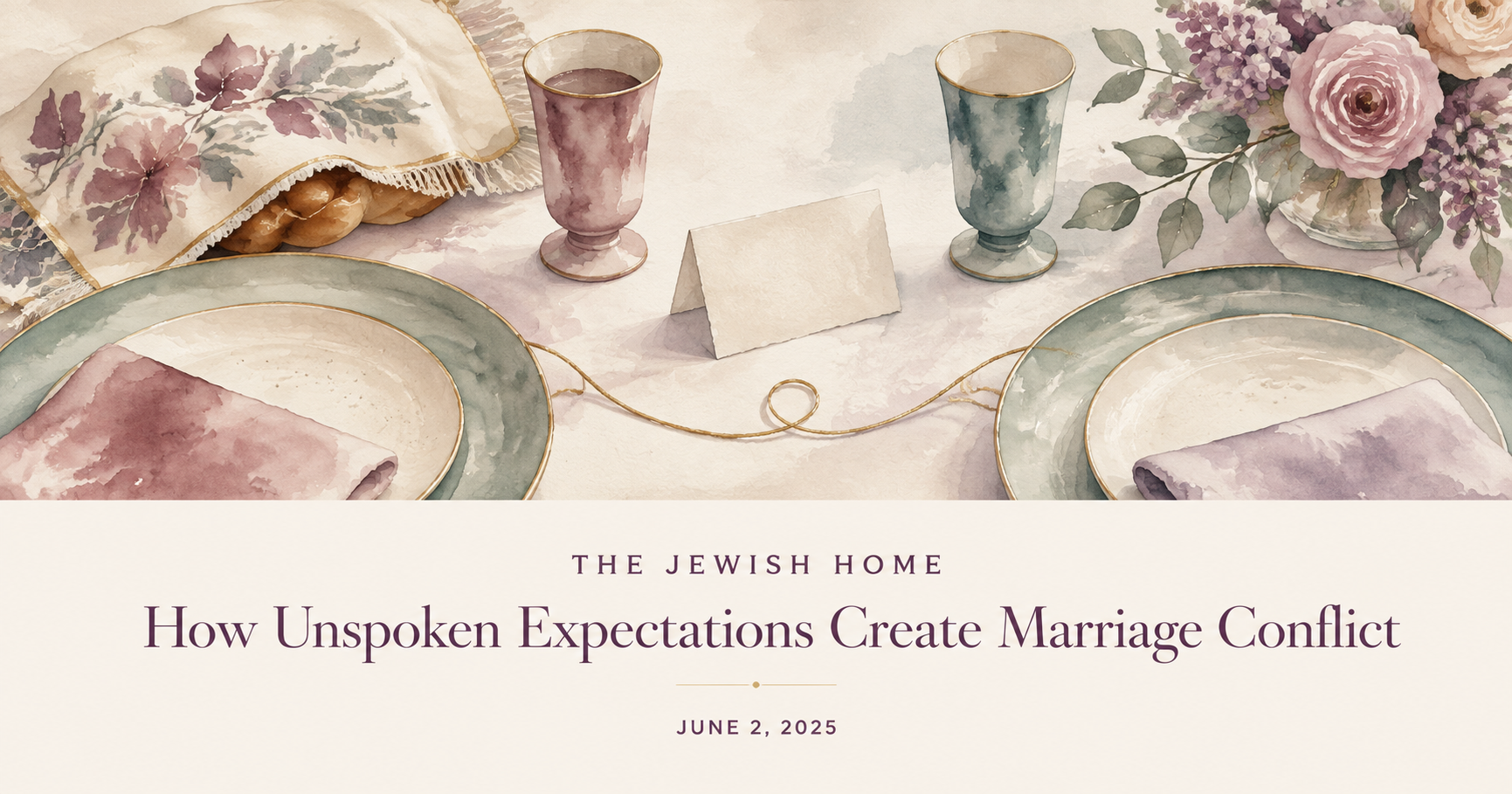
How do unspoken expectations create conflict at the Shabbos table?
Unspoken expectations can turn meaningful family moments into tests neither spouse knows they are taking. Conflict softens when couples discuss the picture each person is carrying, separate preferences from necessities, and choose connection over a perfect script.
Everyone thought the Goldmans had a picture-perfect Shabbos table. White tablecloth, sparkling leichters, and polite children in matching outfits—the whole scene could've made it into a Jewish magazine: a perfectly plated appetizer, a steaming cholent, zemiros, and divrei Torah. But beneath the cholent pot simmered something else entirely: years of silent frustration. When Rivky and Yossi came to me, it wasn’t about some dramatic blowup. They weren’t fighting over money or discipline or significant hashkafic differences. It was the Shabbos table — or more accurately, what the Shabbos table meant to each of them.
Rivky loved the formality and structure of Shabbos. She saw the seudah as the crown jewel of the week — a moment of spirituality, connection, and yes, a little elegance. She planned her menu down to the garnish. She laid out matching bentchers. She even printed divrei Torah for the kids “just in case.” For Rivky, this wasn’t about being showy but about creating a sense of kavod and beauty she’d always dreamed of. Yossi, on the other hand, had a very different vision. For him, Shabbos was a chance to exhale. As a busy working father of five, he looked forward to the seudah as a time to relax.
That meant light banter, letting the kids eat dessert first if it made them happy, and maybe — just maybe — skipping some of the zemiros to schmooze with a guest. He wasn’t trying to sabotage anything. He was just… being himself. For years, they quietly tolerated each other’s styles. Rivky would drop carefully worded hints like, “Maybe this week we can go around the table and each share something meaningful?” or “Wouldn’t it be beautiful if we all sang together?” Yossi would nod, smile, and then default to his usual jokes and peanut-smuggling contests with the kids.
One Friday night, the real tension came to a head when one of their sons let out an impressively loud burp during kiddush. The kids cracked up. Yossi chuckled. No one blinked. Except Rivky. She stared across the table and said, “I feel like I’m running a show no one wants to attend.” Yossi looked stunned. “What do you want from me?” he asked. “Everyone’s relaxed. Isn’t that what matters?” That’s when they came to see me. In our sessions, we didn’t start with table etiquette or who was “right.” We started, as I often do, with stories. When Rivky described her childhood, she shared a home where Shabbos barely registered. Meals were rushed.
Guests were rare. Her mother often lit candles late, still frazzled from the week. There was no Torah shared, no singing, no structure. Rivky had always longed for a home where Shabbos felt like royalty, where it meant something. Yossi’s memories were the opposite — and equally painful. His family was very structured. But it came with intensity, criticism, and pressure. One wrong word at the table could mean a lecture. One missed zemer could be seen as a lack of yiras Shamayim. For Yossi, the strictness felt suffocating. He’d promised himself that his Shabbos table would be warm, relaxed, and full of joy, not judgment.
Suddenly, their weekly standoff made sense. Rivky wasn’t just trying to control the table — she was trying to elevate it. Yossi wasn’t trying to dismiss her efforts — he was trying to protect the peace. Neither of them was wrong. They were carrying two very different Shabbos stories — and trying to rewrite them in opposite ways. So, what helped them? First, we created a shared vision. I asked them to step back from logistics (napkins, zemiros, who says divrei Torah) and instead focus on feeling: What do we want Shabbos to feel like in our home?
The answer wasn’t “elegant” or “relaxed.” It was deeper: they both wanted connection, joy, and peace. Once they agreed on that, they could compromise on the details. Rivky let go of some of her perfectionism. She stopped printing divrei Torah for everyone and accepted that a mismatched bentcher wouldn’t ruin the ruach. Yossi made a conscious effort to sing at least one zemer each meal and helped guide the kids to participate in quieter moments. They also learned to speak more openly and kindly about what Shabbos brought up for each of them.
Rivky shared how the laughter sometimes made her feel invisible, and Yossi shared how the structure sometimes triggered anxiety. With that understanding, they could work together, not against each other. Here’s what I want you to take away from their story: Takeaway Tips: 1. Don’t judge the moment — explore the meaning. If your spouse seems overly rigid or overly casual, ask: What does this mean to them? What are they trying to protect or create? Beneath every behavior is a story. 2. Share your Shabbos memories. Often, our present-day struggles are rooted in childhood experiences.
Understanding your own emotional Shabbos history — and your spouse’s — can open the door to real empathy. 3. Create a shared vision. Forget for a moment how things “should” look. Instead, ask: What kind of feeling do we want to create? Then work backward from there. 4. Choose connection over control. You can have the perfect table and still feel alone. Or you can have a messy table full of love. The choice isn’t always either/or — but when in doubt, lean toward connection. Because in marriage — and at the Shabbos table — peace is more important than polish.
Frequently Asked Questions
How should couples discuss Shabbos expectations?
Talk before the pressure builds. Identify what matters most to each person and agree on a realistic plan for roles, timing, guests, and flexibility.
How can couples apply this insight?
Begin with one calm conversation and one small, repeatable action. Focus on the shared pattern rather than blaming either spouse.
Keep going, together
Full access to every plan, practice and check-in in the Emotional Marriage Method. Small steps you can actually do, in the middle of a real week.