
How Shalom Bayis Begins Outside the Home
 By Sara Freed · July 25, 2025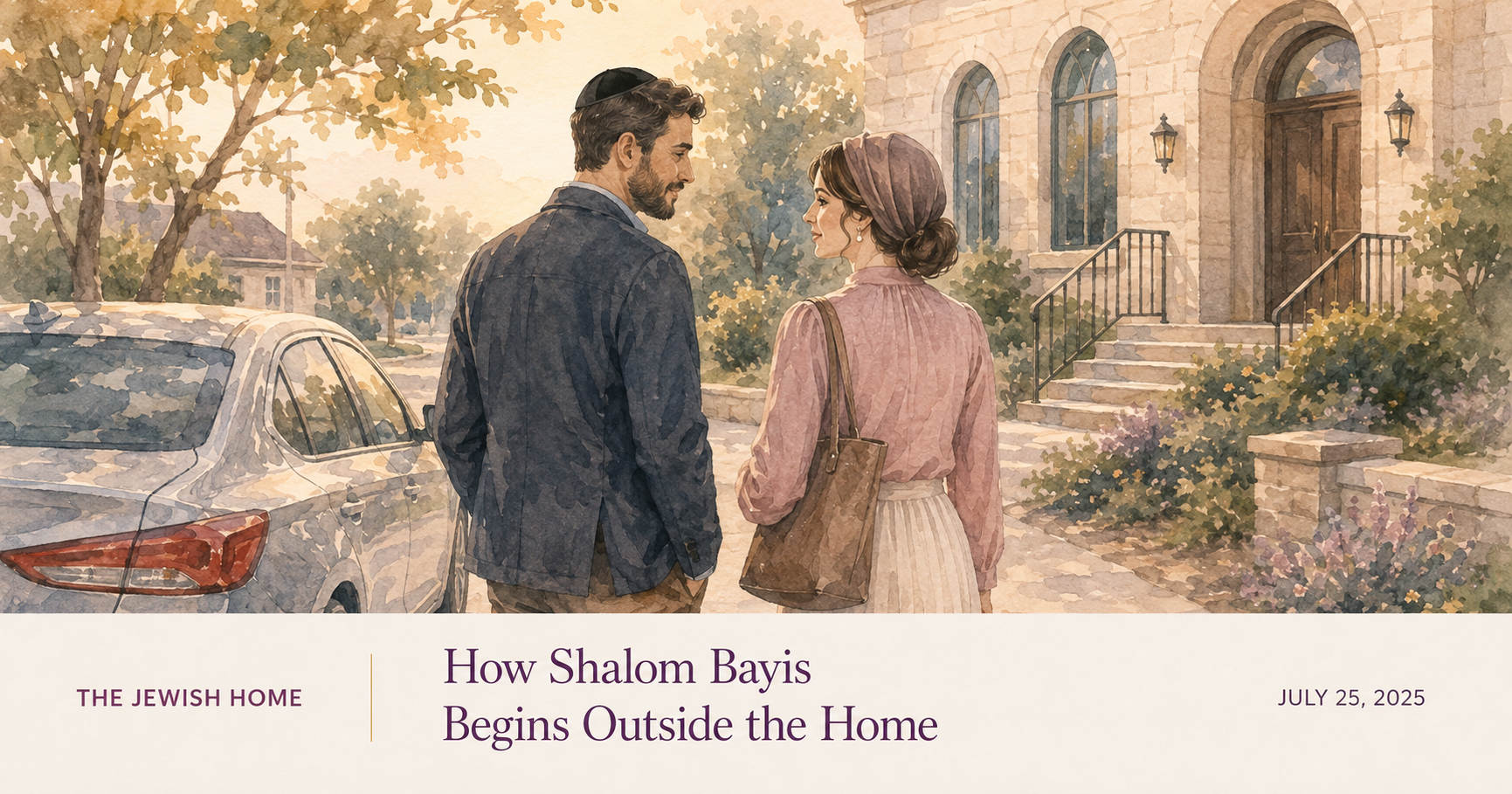
Where does shalom bayis begin?
Shalom bayis begins before a couple walks through the front door. The patience, humility, generosity, and respect practiced in public settings, including the parking lot of the beis midrash, shape the habits each spouse brings into the home.
In the Jewish world, Torah learning is one of our highest values. We cherish it, honor it, and build our lives around it. The sound of Torah in a Beis Midrash is one of the most beautiful melodies in the world. But there’s a sound also holy, also meaningful: the words a husband says to his wife when he walks through the front door. I once worked with a couple—let’s call them Chaim and Suri. Chaim was a serious learner. He had a chavrusa before Shacharis, during his lunch break, and again after Maariv. He was the kind of man you looked at and said, "Wow, he really lives for Torah." But Suri felt alone.
Not disrespected, not unloved—just... invisible. "He comes home," she told me, "and his head is still in the Gemara. I don’t need roses. I just want him to notice I exist." To his credit, Chaim listened. We explored a simple but powerful idea: a transition ritual. Just like he prepared for davening or learning, he could prepare to come home. He started something small. After parking outside the house, he'd take a minute in the car to pause. One deep breath, and a consciousness to be fully present when he walks through the door to his home. Then he'd walk inside, look Suri in the eye, smile, and say, "Hi.
Glad to be home, how was your day?” It sounds small, but to Suri, it was everything. Chazal teach us that a true talmid chacham is recognized not only by his learning, but by his middos at home. The Rambam writes that a person’s greatest test of character is in how he treats his household. It's not enough to be respected in the beis midrash if we’re careless with our words at the dinner table. The Torah we learn must transform how we live, especially with those closest to us. That transformation begins not with intellectual brilliance, but with emotional presence. It's not that our learning or working on ourselves are less holy—chas v'shalom.
But there’s kedusha in a smile, in patience, in washing the dishes when your spouse is exhausted. There’s Torah in the way you listen. Shalom bayis isn't built in sweeping gestures. It's in the moment your spouse feels you turned toward them instead of away. One client told me something unforgettable. "When my husband walks in the door, I don't need him to solve all my problems. I just need to know I'm more important than his phone." That hit me hard. We live in a world of distraction. Alerts, texts, shiurim, headlines. It’s easy to miss the person sitting right across from us.
But Hashem gave us marriage not just to stretch us, but to center us. The way we greet our spouse, the way we make them feel seen and safe, is a reflection of how deeply we understand the purpose of all our avodah. And let’s not forget, this goes both ways. Wives, too, can get caught up in routines. The kids, the homework, the dinner prep, the group chats. When your husband walks in after a long day, he's carrying a world on his shoulders—even if he doesn't show it. A kind word, a soft look, an "I appreciate how hard you're working" can refill his emotional tank in seconds. No one walks into a home needing a critique.
We all walk in hoping for a soft landing. Years ago, I learned something from my own mistake. My husband came home late one night from a meeting after his shiur, and I said to him, "Do you know how many times I reheated dinner?" He looked so defeated. Not because I was wrong, but because he was hoping for a smile, and instead got a complaint. I apologized thereafter. And now? I reheat dinner one more time, but I warm my greeting, too. Marriage is full of opportunities to be a little gentler, a little more thoughtful, a little more like Hashem. Just like Hashem greets us with compassion every morning, we can greet each other the same way.
Here are some small, powerful habits that can shift the entire tone of your home: 1. Pause in the car. Before walking in. Take a breath. Reset your mindset. Remember: You’re entering sacred space. 2. Greet your spouse first. Not the kids, not the notifications—your spouse. 3. Make eye contact. Sounds basic, but it’s big. 4. Express one sentence of appreciation right away: "It’s so good to see you," or "Thank you for today." 5. Take turns decompressing. One person may need ten quiet minutes. Respect it. Trade off. A warm hello can be the difference between a tense evening and a peaceful one. It sets the tone.
It tells your spouse: You're safe here. You're wanted here. Shalom bayis doesn't start in a therapist's office. It starts in the parking lot. It starts with a decision to be present. It starts with a choice to turn toward each other, again and again. And if you ever forget, just imagine Hashem waiting for our tefillos, even when we show up distracted or rushed. He still listens. He still welcomes us. That’s our model. Let your words be like a warm welcome home.
Frequently Asked Questions
How can everyday conduct strengthen shalom bayis?
Practice the same courtesy, patience, and favorable interpretation with your spouse that you would offer respected members of the community.
How can couples apply this insight?
Begin with one calm conversation and one small, repeatable action. Focus on the shared pattern rather than blaming either spouse.
Keep going, together
Full access to every plan, practice and check-in in the Emotional Marriage Method. Small steps you can actually do, in the middle of a real week.