How to Turn Your Expertise Into an AI-Powered Tool Without Flattening It
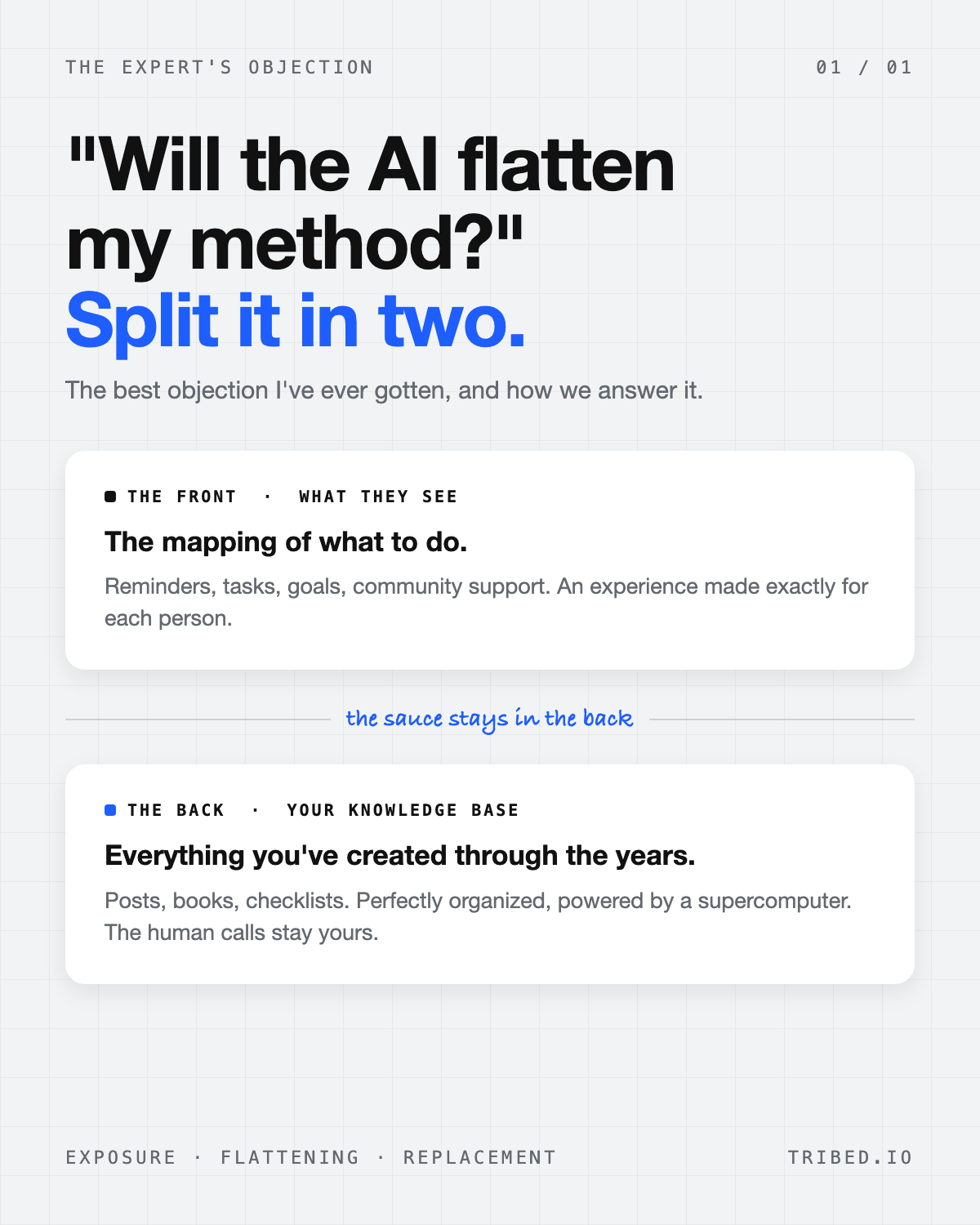
A prospect sent me the sharpest objection I have heard in two years of building AI-powered apps for experts. He runs a diagnostic method he spent years refining, and before agreeing to anything he set one condition: he wanted enough detail to judge whether the tool would strengthen his method or turn it into a generic task programme.
Every expert who considers productizing hits this wall. Coach, consultant, therapist, advisor, engineer: the moment your expertise becomes software, you fear it stops being yours. This article is the answer I gave him, and it applies to any field where people pay for your judgment.
Why do experts fear turning their expertise into an AI tool?
The fear comes down to three distinct risks: exposure, flattening, and replacement. Exposure means anybody that pays a subscription can see what your method is about. Flattening means it becomes a generic checklist that does not deliver the sauce of the method. Replacement means that if the AI is doing it, what is left for you to do?
The flattening fear has data behind it. Linear content does not hold people: free online courses complete at roughly 5 to 15 percent, with a median completion of 12.6 percent across MOOC studies (Open Praxis, 2024), and Katy Jordan's landmark analysis put the average even lower at 7.6 percent (Inside Higher Ed, 2013). Generic apps do no better: about 77 percent of users abandon a new app within 3 days, and only around 4 percent are still there by day 30 (Andrew Chen, industry retention benchmarks). If your expertise becomes one more linear checklist, it inherits those numbers.
All three fears are legitimate. Most builders wave them away with a claim like "the tool keeps your voice." A claim is not proof. The proof has to be structural: the tool has to be architected so the fears cannot come true.
How do you split your expertise? The front and the back
You split your expertise into two sections. The front is what people see and do: the mapping of everything technology can enable, what they need to know and act on to bring to reality the thing you know deep in your bones. The back is everything you have created through the years: your posts, your books, your checklists, organized into a knowledge base and powered by AI.
Think of how a doctor works. The differential diagnosis happens in the doctor's head. The patient hears the prescription. Nobody accuses the prescription of exposing medical school. Your tool works the same way: the user gets the next action; the sauce stays in the back.
- The front (what they see): reminders, daily tasks, goals, community support, the next action in your words.
- The back (your knowledge base): your posts, books, checklists and frameworks, organized and queried by AI to shape every recommendation.
This split is what makes the experience personal instead of generic. Everybody that comes in contact with your method gets an experience made exactly for them, because the AI assembles it for each person from your material, instead of pushing the same linear sequence at everyone.
How do you keep your method from becoming a generic checklist?
Personalization survives when the user's own answers shape what the tool serves them. Two users who give different intake answers should never walk the same sequence. In practice that means the intake questionnaire and every check-in feed what comes next: a user who reports a bad week is not pushed to step 12, they get the recovery guidance your method prescribes.
- Map your real decision points: where do you, the expert, change the plan for a client?
- Collect the back: every post, book, checklist, and framework you have created, in one organized knowledge base.
- Write the front in your own words: the actions, the reminders, the goals, one step at a time.
- Mark the calls that need you. Those stay human.
Personalization is also the retention mechanism. Behavior change runs on repetition: forming a habit takes 66 days on average, with a range of 18 to 254 days (Lally et al., UCL, European Journal of Social Psychology). A user only shows up for 66 days if what they see each day still fits them. I wrote more about the mechanics of meeting users inside their existing habits in the habit-stacking piece.
Where does the human expert stay in the loop?
You do not get replaced, because the human touch and the emotional commitment are still needed. The sticking points that require copious amounts of context are exactly where you dedicate your time. A well-built expert tool has an explicit escalation path: when a user's situation falls outside what the back can answer, the case routes to you, not to a generic AI guess.
This is also what protects your premium work. The tool handles the daily 95 percent; your judgment, the part clients actually pay premium prices for, stays scarce and human. An AI assistant inside the tool answers in your voice, trained on your material, and it is scoped: it explains, encourages, and clarifies the current step. It does not invent new advice.
This division is also the economics of the model. The tool is rarely the whole business; it is the filter that shows you which users are ready for high-touch work. I broke down the actual revenue numbers by audience size in this benchmark analysis.
What should you ask before building?
Five questions split any expertise cleanly. Write the answers down before any build starts:
- Which decisions do I make differently for different clients, and based on what information?
- What have I already created through the years that belongs in the back: posts, books, checklists, frameworks?
- What does a user need to see to act today, and nothing more?
- Which situations always need my personal judgment, no matter what?
- What would make me proud to see under my name on a stranger's phone?
FAQ
Does putting my expertise in an AI tool expose my intellectual property?
No, not if the back stays server-side. Users see only the front: the next action and its explanation. The knowledge base and the logic that assemble each recommendation are never rendered on screen, the same way a prescription does not expose the diagnosis behind it.
Will an AI assistant replace my judgment?
No. A scoped AI assistant explains and supports the current step in your voice, drawing on your own material. The sticking points that require copious context escalate to you. The tool absorbs repetitive daily guidance; the judgment calls that justify premium pricing remain yours.
How is this different from selling a course?
A course delivers the same linear content to everyone, which is exactly the flattening experts fear, and it completes at 5 to 15 percent. An expertise tool assembles a personalized experience for each user from your knowledge base, so the personalization that defines your practice survives in the product.
How long does it take to build an AI-powered expertise tool?
The build itself is now measured in days, not months, with AI-assisted development. The real work is the split above: collecting the back and writing the front in your voice. Budget more time for that than for the software.
If you want to see how this looks in a live product, this is what I build every week at Tribed: branded apps and AI tools where the expert's thinking stays the expert's.
Turn your expertise into a branded app business
Your programs, community, payments, content, automations, and an AI coach trained on your method and voice—built into one app for the App Store, Google Play, and web.